Showing posts with label Catalonia. Show all posts

Saturday, December 14, 2013

Two photographs that will mark the future of Catalan politics

by Vicent Partal. Originally published in VilaWeb on December 14, 2013.

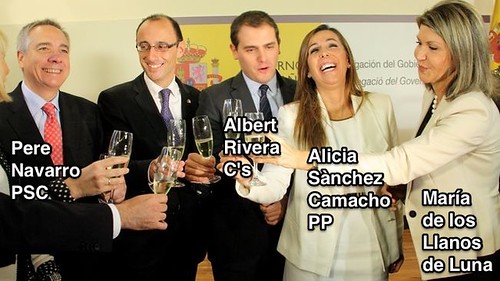
Taken within a week of each other, the juxtaposition of the photograph of Pere Navarro (Catalan Socialist Party) with the Spanish rightist parties with that of photo of the parties announcing the pact on the referendum perfectly outlines the current political scenario

Josh King wrote a book years ago titled Dukakis and the Tank in which he analyzes the history of the relationship between politics and photographs. The title refers to the devastating photograph of the former governor of Massachusetts that wrecked his presidential campaign against Bush Sr. Photographs, according to King, can send more powerful messages than speeches.

A bad photograph in particular can ruin an entire political career or put that person's capabilities in doubt. In our country, the famous photograph of a smiling Josep Lluís Carod Rivera (Catalan Republican Left) while posed with a crown of thorns in Jerusalem while being photographed by President Maragall played a significant role in constructing a certain negative image of the then vicepresident. Just like the famous photo of Francisco Camps with Rita Barberà in the Ferrari [both of Valencia People's Party]. Now, within a few days of each other, two photographs have framed the change in the political era that we have begun to feel in the Principality [of Catalonia].

On December 5, like every year, the controversial delegate of the Spanish government in Catalonia, María de los Llanos de Luna, held a public event in the delegation's headquarters to commemorate the Spanish Constitution. The PP and Ciutadans parties were longtime attendees at this event, which was systematically avoided by the rest of the Catalan political forces. This year, however, the leader of the Catalan Socialist Party, Pere Navarro, decided to go. Former presidents Montilla and Maragall (both Socialists) had never attended but nevertheless he went and found himself in the photograph. With a glass of sparkling cava in his hand, a smiling Navarro posed with Alicia Sánchez Camacho, Llanos de Luna, and Albert Rivera. The impact was immediate.

Navarro, Rivera, Sànchez Camacho and Llanos de Luna

Twitter and Facebook were flooded with surprise and outrage. Many socialists expressed their annoyance with a photograph that added to the Catalan political conversation an image of the socialists in the hands of the Spanish right. The truth is the scene was more complicated than that. Navarro wasn't sure whether to join the toast and it was Camacho who pulled him in and put him in front of the camera. The head of the PSC, however, didn't know how to react. In most of the photographs, his body language reveals his discomfort: he is in one corner of the image while Llanos de Luna and Sànchez Camacho take up most of the center of the image. But the result is complete and devastating: PSC joins the pro-Spanish front and subjects its opinions to the People's Party. Navarro left the Spanish government delegation building quickly, just after the photo was taken, surely without realizing the impact it would have.

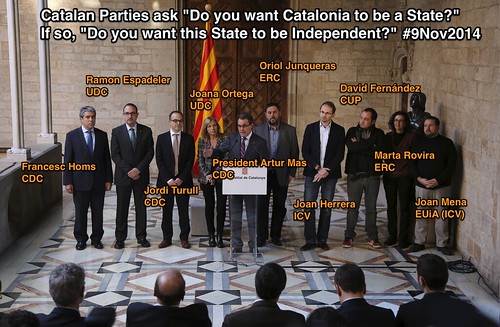
Just one week later, at about the same time of day, the counter-photograph emerged. The leaders of CiU, ERC, ICV-EUiA and the CUP appeared together solemnly in the Palace of the Generalitat [Seat of Catalan Government] to announce the agreement on the referendum. They filed out from the office of the president and assembled behind the podium adorned with the official seal of the Generalitat. The president's head of protocol slightly reorganized the order of those on the right side of the photograph—curiously, the representatives of the leftist parties. In the front row were a few chairs in which were seated some of the heavyweights in the president's office, including Jordi Vilajoana. Behind were dozens of photographers and cameramen ready to capture an undoubtedly historic moment. The Catalanist bloc had achieved the photo, and further displaced Pere Navarro and the PSC who now found themselves linked with the extreme right and far away from the solemn political unity underscored by the Gothic Hall in which the announcement was given.

Catalan Parties come to agreement on Referendum question

Curiously enough, at the same time, Navarro himself was just a few yards away, in the Plaça Sant Jaume, oblivious to what was going on inside the Generalitat and the redoubled effect that the new photograph would have on him. Now it wasn't just a question of what he was doing in the first photo, but how it was that he wasn't in the second one.

Friday, December 13, 2013

Why has Catalonia chosen a double question for its referendum?

Yesterday, the five major parties in favor of Catalonia's right to decide announced that they had come to a consensus on the question and date of the celebration of a referendum for Catalonia's political future. The question will have two parts. First, "Do you want Catalonia to be a State?" and if the answer is yes, then "Do you want this State to be Independent?" The date set for the referendum is November 9th, 2014.

Catalan Parties come to agreement on Referendum question

Why a double question? They are trying to please everyone. Spain has refused all overtures of holding a legal referendum, but there are still six principal parties in the Catalan Parliament who have expressed support for Catalonia's right to self-determination: CDC and UDC, which form the CiU (ruling) coalition (50 seats), ERC (21 seats), PSC (20 seats), ICV (13 seats), and the CUP (3 seats). Two parties are steadfastly against: PP (19 seats), and C's (9 seats).

But keeping the pro-self-determination parties together has been an exercise in herding cats. CDC, whose leader Artur Mas, is Catalonia's president, has supported a referendum since Spain's PM Rajoy closed the door on a better fiscal relationship with Catalonia in the fall of 2012. Many CDC leaders have been forthright about being in favor of independence. But their partners, UDC (Christian Democrat, business friendly), say they are confederalists and defend creating a state, without defining what sort of state that would be. The question is often posed: a state like Massachusetts, Bavaria, or Denmark? The answer is not clear.

ICV (eco-socialists, former communists) says they are federalists and want to offer a choice to constituents to remain within Spain, as a partnership of equals, and were even able to get their associated Spanish party, IU, to declare its support in favor of Catalan self-determination. However, both ICV and IU are minority parties in their respective parliaments with little power over creating the federalism they support.

The PSC (Catalan Socialist Party) is a special problem. Federated with the Spanish Socialists who have repeatedly rejected any right to self-determination for Catalonia, the PSC has insisted that such a right does exist, as long as it is first negotiated with the Spanish State (which adamantly opposes it). The PSC espouses federalism and promise reform to the Constitution, despite the fact that support for such reform is nonexistent both in the ruling PP party and in their own federation.

Nevertheless, the PSC, while currently on a downward spiral (the latest government poll indicates that only 5.6% would vote for that party in Parliamentary elections) are a historic Catalan party which even managed to grab the highest percentage of votes in the 2003 elections. Nobody wanted to leave them out, even after they declared they no longer supported the process a few weeks ago.

And there is lots of bad blood and long history between all the parties, and big doses of mistrust from the people. CiU, who led the Catalan Parliament for 23 years with a strategy of accommodation sometimes called "fish in the cave"—imagine waiting in the shadows and darting out to pick up crumbs—but which now leads the process, has not been able to completely shake off doubts about its sincerity, especially since it has insisted on sticking to vague terminology like the "right to decide" (decide what?) and "own state" (whose state, what kind of state?).

The parties defending federalism never quite explain how they will federate with a State that has steadfastly refused to talk to them. ICV is sometimes rabidly anti-CiU, claiming that its pro-independence stance is merely a smokescreen with which to hide budget cuts, austerity economics, and privatization that favors business interests. CiU counters that Spain's fiscal disloyalty demands such policies and that ICV complains from the comfort of the non-governing opposition.

And the surging ERC (Republican Left) and the CUP (Radical Left)—both of whom support independence in so many words—are accused of pie-in-the-sky dreaming without the hands-on experience that actual governing requires. It all goes round and round.

And it's not all up to the politicians. The civic movements that have brought independence to the fore are led by grassroots organizations like Ómnium Cultural, the Catalan National Assembly, and the newer Súmate. These groups—who managed to get 1.5 million people to demonstrate on Sept 11, 2013 and another 1.6 million to hold hands from one end of Catalonia to the other end 400km away—have insisted that the question be clear and unequivocal—and about independence.

In the end, the spectre of disunion brought them together. The common perception is that Catalans are incapable of consensus, that if there are three Catalans, there will be four opinions. But to not have reached an agreement on the question and date by the Dec 31 deadline would have been political suicide. A double question allows both federalists and confederalists to feel like they can participate while giving the pro-independence movement their very first chance to vote on the creation of a new Catalan state. Education will be a key factor in the campaign.

I think it's the best they could do.


Tuesday, December 10, 2013

Catalonia expelled from the EU?

The most important thing will be continuing to participate in the European Economic Area, and Spain can’t keep that from happening


Last Tuesday the Barcelona-based daily, El Periódico, highlighted a response from the European Commission (EC) to one of my parliamentary petitions. The EC has now finally answered what the PP and PSOE have asked for such a long time: “If part of a country becomes a new independent State it will become a third country and the treaties would no longer be applicable.” Let’s take this bit by bit. The EC has given me different answers to my questions on this matter. On November 12, 2012: “It’s not up to the EC to state a position on matters of internal organization of its member states.” On February 23, 2013: “The conditions of the EU treaties are decided by its member states.” Does the recent answer have anything to do with the growing political pressure and to the fact that some of the commissioners finish their terms after the upcoming European elections?

It is the European Court of Justice in Luxembourg, and not the European Commission, which interprets the treaties of the EU and it is the International Court of Justice in the Hague that has the last word in the case of a unilateral separation of a Catalonia expelled from the EU. Its recent decision on Kosovo, however, was not exactly in Spain’s favor. In addition, in the European Parliament, the PP and PSOE have been isolated and have roundly lost various votes when they have tried to block Kosovo’s entry into the EU. They have also been left alone on votes on the Single European Patent, the central rail crossing of the Aragonese Pyrenees, and the Parot Doctrine.

The exit from the EU would be just as long a process as entry is. In Brussels they say that if Great Britain votes to leave the EU in 2015, the negotiations will go on for years and the EU will try to preserve the application of as many of the EU regulations
as possible. Scotland is not Turkey. The previous argument reinforces the idea that an independent Catalonia would have enough time to renegotiate from the inside its reincorporation into the EU. That’s what expert Graham Avery wrote in an article published on the British Parliament’s website: an independent Scotland would negotiate from the inside its quick reincorporation into the EU. Avery defends the fast track and discards the idea that Scotland should have to get in line after Turkey, as Spain has said. The Economist, the most influential weekly economics magazine in the world and a proponent of a ‘no’ vote in Scotland, maintains in an article about Scotland (November 3, 2012) that “its candidacy would be fast-tracked by the European Commission, with a heavily EU-dependent Spain ultimately unlikely to oppose it.”

The EU is still just a union of states, nothing close to a federal Europe, with an annual budget only four times larger than that of the Catalan Generalitat government (130 billion, or 0.8% of the GDP of the EU-28). In the EU, Spain is famous for its record of non-compliance and faulty implementation of EU regulations, and has hundreds of ongoing complaints for illegal aid to the State. Those that from Madrid call for a strict and literal application of the law are not exactly the best students to be asking for expulsions.

The most important thing for Catalonia is to keep participating in the European common market—the European Economic Area (EEA)—that guarantees the free movement of goods, persons, services, and capital among the EEA countries and is the true source of progress and wealth in Europe. This is the great European success story of the 20th century, that today is being imitated by other continents creating similar free movement treaties. Switzerland, Norway and Andorra—which aren’t members of the EU—have agreements with the EU in order to be part of this special Area.

If Catalonia were expelled from the EU, it is the EU that would have the exclusive jurisdiction for negotiating agreements with respect to the EEA, and since the Treaty of Lisbon, unanimity is not required for approval: Article 207 establishes that they can be approved by a supermajority of countries (two thirds) along with a favorable vote in the European Parliament.

Spain doesn’t on its own have the right or the capacity to effectively veto Catalonia’s membership in the EEA, which today comprises 500 million people. Spain does not have the capacity to rally a blocking minority in the EU (one/third) to expel Catalonia from the EEA: here in Catalonia there are 4000 European multinationals that will never allow themselves to be expelled from the EEA.

A country’s potential for leadership in the EU does not come from its size but rather from its good practices with respect to other member states. That is why some small countries are leaders and some large countries are not. Brand Spain these days is valued below zero on the EU scale, as Ignacio Molina, a professor in Madrid, explained recently in a devastating article for the Elcano Foundation, also based in Madrid (March 13, 2013). The PP and the PSOE would do well to negotiate with Catalonia as Cameron has done with Scotland. As The Economist said (December 22, 2012), “with the outlook so grim, it is no surprise that Catalan politicians talk seriously of secession”.

Ramon Tremosa is a Member of the European Parliament for Convergència Democràtica de Catalunya


Thursday, September 26, 2013

10 Things You May Not Know About Barcelona

I am happy to share with you this essential list of the Top Ten things that every visitor should know before landing in Barcelona, designed by my good friends at Can Antaviana, with text by yours truly.

Em plau presentar-vos un recull imprescindible de les 10 coses que tot visitant hauria de conèixer abans d’aterrar a Barcelona, el disseny del qual l'ha realitzat de forma encisadora els genis de Can Antaviana. Un plaer col·laborar amb el texte.

Sunday, August 25, 2013

Germany debating unusual formulas for Catalan State within the EU

Originally published in VilaWeb on August 25, 2013

A study proposes using the example of Cyprus “in the reverse” to maintain the Catalans' rights within the European Union

A study carried out by German political scientist Kai-Olaf Lang, published by the German Institute for International and Security Affairs (Stiftung Wissenschaft und Politik), proposes an unusual formula to sidestep the debate of whether, after declaring independence unilaterally, Catalonia would continue to form part of the European Union. According to Lang, the European Union should follow the Cyprus model, but in the reverse. This would mean that the new Catalan state would momentarily not form part of the Union but on the other hand, the Community acquis, or set of rights and obligations of European citizens currently in place, would continue in force in Catalonia, and thus Catalan citizens would maintain all of their rights as European citizens.

The German Institute for International and Security Affairs is a prestigious, independent, private think tank that has offered advice to the German government and parliament over the last fifty years on foreign affairs, through their published reports. Kai-Olaf Lang's report was published in the Institute's free current affairs magazine.

The report believes that Spain should make a significant federal offer to Catalonia and that that could possible abort the independence process, but it also openly raises the possibility about what would happen if the State is incapable of making such an offer, and thus the current sovereignty process ends with a declaration of independence like that made by Kosovo.

According to Lang, Cyprus' model could be used. Officially, the whole island of Cyprus is part of the European Union, but in actuality, the territory of the Turkish Republic of Northern Cyprus is excluded from European Community rules. Officially, the European laws, or acquis, are in force in Northern Cyprus, but the EU has suspended their application until adequate conditions are met. In the Catalan case, the Union would declare the European acquis to be in force in Catalonia even though the Catalan State would remain outside of the European institutions during the period in which it is acquiring membership.

The acquis is the set of legislative rules and laws, and court decisions that constitute the legal body of law in the European Union.

Monday, April 29, 2013

A Catalan State could benefit Spain

by Núria Bosch, originally published in Ara on 29 April 2013

I have heard it said that the independence of Catalonia would devastate the Spanish economy, and that this might be a reason for the European Union to be less than interested in the progress and success of the sovereignty process begun in our country of late.

But in light of this statement, it would be wise to take a look at the recently published paper titled "Where Spain is headed", from the Cercle Català de Negocis (CCN), a business association in favor of the Catalan State. The paper, among other things, talks about the benefits that the independence of Catalonia might bring to Spain. I found the reasons interesting, and thought I would comment on them here.

The first point is that independence could be just the catalyst for changing the economic and political model that the Spanish State needs. The idea is that, in order to get beyond the financial crisis, Spain needs to change its productive model, shrink its administrative structure, and replace its political and business elites.

That's all true. It has cost Spain dearly having an economic model based on construction and tourism, which both have a low added value, instead of promoting industry, research, and innovation. The Spanish government has failed to implement an economic policy in order to increase productivity or competitiveness both in the Zapatero era and now in Rajoy's administration. It has performed badly, on the fly, late, and with contradictions. You only have to look at the results of the economic policy that has been implemented, which generates a vicious circle of low growth and high unemployment and debt. And it doesn't look like the latest reforms make any attempt to change the economic model either. Therefore, Catalonia's independence may be the detonator that pushes Spain to change its productive model.

A second point is that a Catalan State would allow Spain to fully develop its own economic strategies. Catalonia and Spain have distinct business and economic strategies. The Catalan strategy is based on small and medium-sized, innovative, flexible, niche and export market-oriented businesses with a strong technology and industrial component. In contrast, the Spanish strategy is based on large businesses which operate in regulated sectors (banking, electricity, hydrocarbons, telecommunications, etc.) with a very important international presence, especially in Latin America.

In order to be successful, these two strategies require distinct (mercantile, labor, and financial) legislation and policies (especially with regard to infrastructures). So, the independence of Catalonia will allow the Spanish government to establish policies that are adequate for its own business model and to concentrate all its resources on Spanish companies, which will reinforce its competitiveness and job creation.

A third point is that the competition between the Catalan and Spanish economies on equal terms, each with their own state structures, would help Spain to progress. Well supported competition from an economic point of view always generates more efficiency and might push Spain to construct basic infrastructures according to their profitability and to abandon pharaonic white elephants. At the same time, the competition might encourage Spain to develop the tools it needs to compete with Catalonia to attract foreign investment. All of which would end up improving the competitiveness of Spanish businesses, which would increase the country's wealth.

In that same way, a Catalan State would have to dedicate resources to investments in infrastructures in order to strengthen the Catalan economy. This fact, which not only would facilitate the import of Spanish products and the export of products to Spain, would also reinforce the competitiveness of Spanish businesses, since it would make it easier for them to send their products to Europe.

A fourth and final argument would be that the economic strength of a Catalan State would be beneficial to the Spanish economy. A Catalonia with a strong economy would increase its imports of Spanish products and Catalan businesses would be able to make investments in Spain that would have a positive effect on its economy, at the same time that Catalonia could offer direct economic support to Spain.

In conclusion, all signs point to the recovery of Spain not having a V shaped curve (of improvement) but rather one shaped like an L (no recovery). Faced with this situation, in the medium and long germ, the independence of Catalonia could benefit the economy of the Spanish state and increase the well being of its citizens.

Núria Bosch holds a Bachelor Degree and a PhD. in Economics from the University of Barcelona. Bosch is Professor of Public Economics at the same university, director of the UB’s Chair in Fiscal Federalism at the Barcelona Institute of Economics (IEB) and one of the directors of the Fiscal Federalism Research Program at the same institute. The Barcelona Economics Institute is UB’s research center that carries out work in Applied Economics. She specializes in fiscal federalism, local and regional public finance, fiscal flows and public sector efficiency analysis. Her work has been published in specialized national and international journals and books, and she is a contributor to What's up with Catalonia?


Friday, April 12, 2013

Catalonia's National Transition Advisory Council will issue report on referendum before summer

Originally published in Vilaweb on April 11, 2013

They will write between 15-20 reports • Homs says the group’s work will benefit both those in favor of and against the creation of a sovereign state.

The National Transition Advisory Council was constituted this evening with the intention of preparing between 15 and 20 reports during 2013 and plans to have a report on the referendum itself ready before summer. The objective is to develop materials and sufficient arguments for debate among both those in favor and against the creation of a sovereign state.

The Councilor of the Executive, Francesc Homs, remarked that the council's work will benefit everyone, because there will be materials and documents that facilitate contrasting ideas, beyond the positions expressed in an electoral campaign, “when things were said that were not clarified or contrasted, because no one had delved very deeply into them”.

The President of the Council, Carles Viver Pi-Sunyer, made an initial proposal for a working plan but hoped to get consensus from the rest of the group’s members. In principle, it foresees developing between 15-20 reports during 2013 divided among four categories. The first is state structures, in which would be included a revenue agency, a central bank, other agencies and regulatory bodies, the judiciary, electoral administration and foreign service, for example.

In the second category are the processes. The most notable is the referendum, the report on which would have to be ready before the summer, but there will also be one on the transition of ordinances and norms (penal and mercantile codes), another on how the relationship will be forged with the EU, the relationship with international organizations, and how the relationship with the Spanish state will be articulated.

The third area is economics, and will contain a study of which resources the Catalan public administration will dispose of and which funding resources it will have to have, how assets and liabilities that are currently shared with Spain will be divvied up, and how contracts regarding goods and services will be dealt with that are controlled by the Spanish state.

The fourth area is reserved for specific topics, like social security, energy matters, security and defense, dual nationality, language and official status of languages.

Homs remarked that the council has a huge task before it and asked that it not be judged until after it files its reports, knowing that there is an “undeniable commitment to doing the job well, since the reports will be examined very closely”. He ensured that the reports would not be based on feelings, but rather on documentation, information, and data, and developed by a completely professional council. “We could have made it more partisan, but we opted not ” he noted.

The Councilor of the Executive recognized that the government's objective was to hold a referendum and with the winning option being the establishment of a sovereign state, but he said that the work of this council would serve those in favor as well as those against, because it would provide material for everyone to debate.

He added that “today, knowing what belonging to Spain means doesn't require a lot of study” because there are everyday examples all around, but that there much less available information about what it what it means to have a sovereign state.

New Members and a vice president

The Council president nominated a vice-president, Dr. Núria Bosch. In addition, a new member was added, Rafel Grasa, director of the Catalan International Institute for Peace. In total, there are now 14 members, with one seat that is temporarily vacant.

The National Transition Advisory Council is presided by Carles Viver i Pi-Sunyer, director of the Institut d'Estudis Autonòmics (Institute for Studies on Autonomy). Its other members are:

Enoch Albertí i Rovira, professor of Constitutional Law at the University of Barcelona

Germà Bel i Queralt, professor of Economics at the University of Barcelona (Twitter)

Carles Boix i Serra, professor of Political Science at Princeton University (USA) (Twitter)

Núria Bosch i Roca, professor of Public Economics at the University of Barcelona (Twitter)

Salvador Cardús i Ros, professor of Sociology at the Autonomous University of Barcelona, and journalist (Twitter)

Àngel Castiñeira i Fernández, director of ESADE-URL's Leadership and Democratic Governing Chair and Department of Social Sciences.

Francina Esteve i Garcia, professor of International Law at the University of Girona

Joan Font i Fabregó, business leader, CEO of Grup Bon Preu.

Rafel Grasa, director of the Catalan International Institute for Peace

Pilar Rahola i Martínez, journalist and writer (Twitter)

Josep Maria Reniu i Vilamala, professor of Political Science at the University of Barcelona (Twitter)

Ferran Requjo i Coll, professor of Political Science at the Pompeu Fabra University (in Barcelona).

Joan Vintró i Castells, professor of Constitutional Law of the University of Barcelona

The National Transition Advisory Council will focus on identifying and analyzing all of the possible legal options for the national transition process, advising the government on strategic structures for the future government and Catalan institutions, optimizing available resources, proposing events and fomenting the distribution of information abut the national transition process throughout the international community and identifying sources of support, and advising the government on deploying institutional relationshiops in Catalonia so as to guarantee the process as a whole.

The Council is part of the Department of the Presidency (Executive), which offers administrative and logistical support, and is coordinated by the head of this department, in agreement with the vice president of the Government. As with other advisory councils of principle aspects of political action in Catalonia, the seats on the National Transition Advisory Council are unpaid positions.

Monday, March 18, 2013

US DOJ Attorney Writes Report on Secession, Sovereignty, and EU

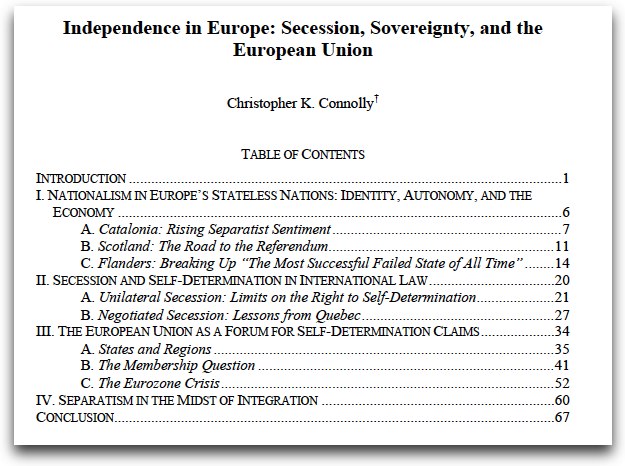
VilaWeb published news that “the US Department of Justice now has a report on Catalonia on its desk”. The report in question was written by Christopher K. Connolly, an Assistant US Attorney with the Southern District of New York of the US Department of Justice. In a footnote, he stresses that the “views expressed in this article are mine alone, and do not necessarily reflect the view of the United States Government or the Department of Justice.” I unfortunately missed this footnote at first, so my first tweets erroneously attributed the report to the US DOJ itself. My apologies.

The Connolly Report is 68 pages long and can be found on the
Social Science Research Network.

I do recommend reading the report in its entirety. Here are my thoughts:

Of course, one of the most important aspects of the report is its very existence. It would seem to indicate that the United States Government is taking the secessionist movements in Europe—particularly that of Scotland, Catalonia, and Flanders—very seriously. Even if the US Department of Justice didn't sign the report, the fact that one of its lawyers did is pretty significant.

Connolly's summary of the events leading up to Catalonia's current political situation is accurate and balanced, if a bit cold. He doesn't explain people's frustration with current dependence on Spain and its power to control Catalonia's culture, language, and finances.

The analysis of whether secession or self-determination are consistent with international law is curious. After some historical background, Connolly concludes that paradoxically,
Although international law recognizes a right to self-determination, such a right, if applied broadly to offer the possibility of statehood to the world’s myriad potential claimants, would result in “the radical undermining of State sovereignty and a dramatic reshaping of the present framework of the world community.” 
and then further
But international law is, first and foremost, a set of rules made by and for states, and states unsurprisingly have been reluctant to condone a  right that would justify their own dismemberment
But I don't think you can have it both ways. Can you claim the benefits of supporting self-determination (“we are broadminded and democratic”) without actually supporting self-determination? I think not.

Connolly then goes on to analyze self-determination in the EU context, rightly pointing out that
The EU, however, changes the calculus for advanced regions such as Catalonia: following independence, if EU membership were secured, Catalans would still enjoy access to Spanish markets and the markets of other EU member states.
The question of EU membership is a key one, and Connolly argues that while it is not guaranteed,
To disentangle these stateless nations from the EU system would be highly problematic and arguably not worth the effort especially since they would almost certainly qualify for membership as independent states.
There was a definite undertone of big-country-unease throughout the report. For example, Connolly cautions against offering intermediate solutions, saying that the British government runs "the risk that many Scottish voters might instead opt for independence." As if it were a bad thing.

He also lauds the "civic" nature of the movements in Flanders, Scotland, and Catalonia, but worries that
Yet the success of Flemish, Scottish, or Catalan nationalism could embolden more divisive nationalist forces elsewhere.
Frankly, it frustrates me that somehow the non-ethnic, thoroughly inclusive (as Connolly himself admits) Flemish, Scottish, and Catalans should be held responsible for xenophobia in Europe.

Connolly makes his position (and home country) pretty clear when he states that
Some states are more sovereign than others by virtue of their size and strength, they are capable of acting with few impediments on the world stage, whereas smaller and weaker states often find their exercise of sovereignty constrained. [emphasis mine]
In the end, however, Connolly suggests three ways to “approach the challenges posed by substate nationalism”

1. States “faced with separatist movements should allow for referendums to gauge support for separation”. Spain has adamantly refused such a referendum up to now. Let's hope they're listening.

2. The EU "should consider expanding the formal opportunities for sub-state
regions to participate in EU policymaking." For me, too little too late. I don't think Catalonia, at least, is willing to wait.

3. The “EU should clarify its position on how it would deal with secession from
a member state.” Yes, I agree.


Friday, February 22, 2013

We are not Scotland, by Vicent Partal

Originally published in VilaWeb, 22 Feb 2013

The first test of the Scottish Referendum was a small disaster. Yesterday, 62% at the University of Glasgow voted against independence in a straw poll that looked to imitate the Catalan straw polls of 2010-2011 and therefore prepare the road towards the official referendum that will take place next year. A referendum that all observers, unfortunately, agree on forecasting as a defeat for Scottish nationalism.

It's sad that that's the case, but, even though we are not very accustomed to taking ourselves seriously, perhaps we might take advantage of the situation to point out some notable differences between their situation and our own. Two of the most noteworthy: the broad base of support and the origin of the proposal. From above in the Scottish case, from the ground in Catalonia.

It's true, and obvious, that the different attitudes of the British and Spanish governments work to our advantage. But that's not the whole story. In Scotland the process is being managed almost exclusively by the Scottish National Party, which faces a ideologically diverse coalition of opposing forces which claim to represent a cross-section of Scottish society. In Catalonia, on the other hand, and this was made quite clear in the last elections, the citizenry want the process to be led not by a single party or single leader, but by a coalition that crosses party and ideological lines. Which is of course more complicated to manage, but also much more robust.

In Catalonia, in contrast with Scotland, the pro-independence movement is first and foremost a grass-roots movement, that has pushed the political parties toward an ever clearer position. It's not anyone's political machinations, but rather a collective need spearheaded by the community, and manifested through various successful initiatives, from the straw polls to the demonstrations, just to name a few.

In Scotland, the independentists have to work hard if they want to win the referendum, and right now it seems like a very difficult mission indeed. Which makes me think two things. First, it'll be better for us to hold our referendum before theirs. And second, it's about time, without any false modesty, that we give ourselves a little credit for the road traveled—so well!—up to this point. And at the same time it would be great if we could shed our fears about winning our future.

Tuesday, February 12, 2013

Turning the Europe debate on its head, by Vicent Partal

Originally published on February 12, 2013.

Will Catalonia be out of the European Union if it becomes independent? It's all speculation, and impossible to call, as we've seen in the last few months, keeping in mind that everything will be negotiable, and negotiated. But yesterday's report from the British Parliament says things that we'd do well to pay attention to. The report makes it clear that right now no one can seriously affirm either that Scotland will automatically become a Member State, or that it won't. But the report argues that leaving Scotland out would be extraordinarily difficult. And that's where the interesting bit of the story is.

Scotland, and Catalonia, are already part of the European Union. And therefore, all of the citizens and businesses that reside there enjoy the privileges and freedoms established by the Union, for example, the free circulation of goods, people, and merchandise—just to name the most obvious.

The question that the British Parliament is facing is the following one: could the Union deprive rights from the citizens that are already members? The debate, formulated in this way, is quite interesting. Because we're not just talking about the Scots or the Catalans. We're talking about Europeans.

Let's imagine that tonight Catalonia proclaims its independence. At 11:59pm, the Seat factory in Martorell, which belongs to Volkswagen, a German company, functions in a situation in which it can move parts and works and sell vehicles throughout the Union. One minute later, if Catalonia is expelled, it won't be able to do so. Is that conceivable?

No, it's not at all conceivable, keeping in mind that for Catalonia to be expelled there would have to be a unanimous vote from the European Council. That is, Germany would have to vote against the interests of its own company. Or Romania would have to vote that all of the Romanian workers would be instantly categorized as foreigners, with all the problems that would entail.

The British, a serious people not inclined to foolishness, have begun to realize that it would be a lot more costly than it seems to expel a territory from the Union. First, because all of the states, unanimously, would have to make a decree about the expulsion. Which is not very likely.

But, what is more—and this is no small detail—because not even the Council (that is the governments), the Commission, or the Parliament would have the last word. The last word would fall to the Court of Justice of the European Union. It could happen, then, that the European Council decides to expel Scotland and Catalonia, but that the Court of Justice immediately stays the decision. In order to more carefully study if it violates the rights of all European citizens, native or foreign-born, residents of Catalonia or Scotland.

And it's important to point out, that the Court has already ruled against Spain: when Spain opposed the right of the people of Gibraltar to vote as British in the European elections.

Friday, February 8, 2013

Spanish Initiative

If you buy a house in the US, or the UK, or in most countries, and you fail to keep up the mortgage payments, the bank has the right to foreclose on your house, kick you out, and sell the house to someone else. Fair enough. If that happens, the repossession of the house satisfies the buyer's financial responsibility to the bank, and the two parties go their separate ways. It is up to the bank to be careful enough when agreeing to a mortgage so that the value of the house secures its investment. And if not, well, the bank earns interest on the loan because of the risk is it willing to take.

In Spain, if you default on a mortgage, according to the current law, the bank will foreclose on your house, evict you, and, here's the real kicker: make you keep paying the mortgage payments. So, not only do they get whatever equity you put into the house, but they get the house, and they get the rest of the loan. It's barbaric. Meanwhile, the mortgagor is on the street, and if they couldn't pay the payments before, you can help me figure out how they'll pay them with no roof over their head.

Many groups have tried to change the law, to no avail. The most recent attempt is by the PAH (Plataforma d'Afectats per la Hipoteca/Platform for those affected by mortgage) who have submitted a "People's Initiative" (ILP: Iniciativa legislativa popular) to the Spanish Congress. So far, they have collected 1,402,854 signatures in favor of changing the mortgage law with some minimum provisions:

• nonrecourse debt, both retroactive and for the future (if the bank forecloses, the debtor is no longer liable for the balance of the payments)
• lodging for those who have been evicted from their houses in empty apartments that belong to banking institutions
• moratorium on primary residence evictions

On Tuesday, the Spanish Congress is slated to vote whether or not to admit the Non-recourse debt ILP for debate. The ruling PP has said it will vote against it, and since it enjoys majority representation in the Spanish Congress, the Non-recourse debt ILP will be effectively dead at that point.

On that same Tuesday, the Spanish Congress will debate a different ILP: one that designates bull fighting as a "Heritage of Cultural Interest" of Spain. Such a law would protect the celebration of bull fighting throughout the Spanish state, and thus overrule the ban on bull-fighting passed in the Catalan Parliament on July 28, 2010.

If that weren't enough, it turns out that the bull-fighting law will be the first Popular Initiative to ever make it to law. It is quite telling—and depressing—that the Spanish Congress can get a law through to force bull-fighting on Catalans, but not update their draconian mortgage system.


Monday, January 28, 2013

Spanish President wants to curtail foreign activity of Catalan government

Originally published in Vilaweb on January 28, 2013

The Spanish government is preparing a law to control international trips, initiatives, and agreements undertaken by the "autonomous" communities

In Catalonia's process toward self-determination, one of the areas in which the Catalan government has begun to put more attention is internationalization. Precisely because of its importance, the Spanish government has proposed stopping the Catalan government's foreign actions, and to that end is preparing a "Law of Foreign Action and Service" according to an article published today in El País. The bill will be presented in the Council of Ministers today for its approval and foresees, among other things, that the Ministry guide and approve the international relations of the autonomous communities.

The autonomous communities could act in other countries but they will have to inform the Spanish government about all of the trips, visits, and initiatives that they wish to undertake. The Ministry will decide if such actions are approved and that will depend on whether or not they are in accordance with the objectives stipulated by the Spanish government. "Unity of movement and coordinated institutional loyalty" will be the principles invoked by the new law.

The Spanish government can't prohibit the president of an autonomous community from making an offical trip, but they can approve it or not. And the Spanish embassies will also disregard such trips.

In addition, the new law also foresees that the Spanish government control any agreements that an autonomous government sign with foreign organizations in order to verify that these do not violate or overstep their jurisdiction and aren't unconstitutional. They will also be refrained from participating in foreign affairs or in international treaties.

Any proposals to create foreign offices will also be subject to prior approval by the Spanish government. Any "recommendation" made on any of these principles will be considered binding in those autonomous communities that have not fulfilled their budget stability objective. Just last week the Catalan government announced that its 2012 budget deficit was 2.3%, 8 tenths over the objective set by the Spanish government.

Wednesday, January 23, 2013

"Largely Symbolic"

"Largely Symbolic" That's how the AP has described Catalonia's landmark Declaration of Sovereignty. On the one hand, that's true: declaring a country's sovereignty is loaded with symbolism. Here is Catalonia finally standing up and saying that it has the right to decide its own future. But if you interpret "largely symbolic" as "having little legal standing" as those newspapers seem to do, then you'd be grossly misled. The Parliament of Catalonia was elected on November 25, 2012 with the highest turnout that that Parliament has ever seen. The Declaration of Sovereignty was approved by a favorable vote of 85 of the 135 Members. It is a monumental step on the road to independence. Symbolic for its significance, I'll give you that.

----

Updates:

Great to see an accurate portrayal in CNN: Catalan Parliament declaration pushes self-determination
"It is not an outright statement of independence, but parliament's declaration insists that the Catalan people, in northeast Spain around Barcelona, have the right to self-determination."

Here's the initial roundup of the immediate coverage of the Catalan Parliament Declaration of Sovereignty, which is distressingly limited to repeated versions of the AP article, a better one from Reuters, and another from DPA, a German press agency.

Europa Online Magazine pretty much has the facts straight (from DPA): Catalan Parliament approves referendum on independence
"The parliament of the large north-eastern Spanish region of Catalonia on Wednesday approved a declaration paving the way for a referendum on independence, despite objections from the national government in Madrid."

And here is the Reuter's story, as it appears in EuroNews Catalan lawmakers pass resolution on sovereignty

EITB.com Catalonia votes on motion calling for right to decide political status

GMA News Online: Catalan lawmakers pass resolution on sovereignty
"Catalonia's parliament approved on Wednesday a declaration of sovereignty signalling the start of an uncertain journey towards a referendum on independence from Spain for the northeastern region."

ABC was first to carry the stilted AP story: Catalonia Declares Itself a Sovereign Entity It's also being carried by The Guardian, Huffington Post, Washington Post and Fox News

Reuters has someone on the ground: photograph: Catalunya's separatist supporters meet at the entrance of Catalunya's Parliament during a session in Barcelona

Catalonia declares its sovereignty

Originally published in Vilweb on January 23, 2013

CiU, ERC, ICV-EUiA and one representative of the CUP vote in favor of the Declaration which defines Catalonia as a "sovereign political and legal subject"• The PSC (Socialists) side with the No of the PP and C's • Five Socialist MPs do not vote


The Parliament of Catalonia has approved a historic document, the Declaration of Sovereignty, which defines the People of Catalonia as a sovereign political and legal subject. This declaration initiates the process of celebrating a referendum on the political future of Catalonia in 2014, in accordance with the commitments of CiU and ERC in their governability accord. These two parties, joined by ICV-EUiA, supported the document, which also received a vote in favor from a representative of the CUP. The other two CUP MPs abstained, in order to criticize the manner in which the process began. The PSC (Socialists) finally sided with the No to self-determination block, together with the rightist PP and Ciutadans, who called the Declaration of Sovereignty illegal and unconstitutional. But five Socialist MPs protested the PSC stance by not voting: Àngel Ros, Rocío Martínez Sampere, Marina Geli, Joan Ignasi Elena and Núria Ventura. There were 41 no votes, 84 votes in favor, and 2 abstentions. (Two PP MPs were ill, and thus did not vote. There are 135 MPs in the Catalan Parliament.)

Tuesday, January 15, 2013

What is a Declaration of Sovereignty and what is it good for?

Originally published in Vilaweb on 15 January 2013

We explain the consequences of a vote like the one that is proposed for the Parliament of Catalonia


The Parliament of Catalonia wants to vote on a declaration of sovereignty before the end of the month. Nevertheless, the political debate has created some confusion about the extent and the value of such a declaration. We offer here some answers to the most frequent questions.

What is a Declaration of Sovereignty?
Normally, a declaration of sovereignty is made by a group of humans, a nation, that declares to the world that from that moment forward they are the subject of sovereignty, that is, that they don't recognize any other sovereignty to be superior to that of their own people.

Is a Declaration of Sovereignty the same as a Declaration of Independence?
Not necessarily. Often a declaration of sovereignty comes before one of independence. It's logical that a people first declares that it is sovereign and then specifies how it wishes to exercise that sovereignty. But it turns out that declarations of independence often come about abruptly, and therefore, sometimes a single document serves both functions.

Are there consequences to declaring oneself to be the subject of political and judicial law?
There are. But only if those rights are exercised at some point. It's possible, for example, to declare a people's sovereignty and never declare independence. In that case, the declaration of sovereignty is simply rhetorical. But if independence is declared, the foundation of this declaration is always rooted in the previous declaration of sovereignty. If the conflict makes it to international courts, the declaration of soverignty would be valuable.

In the case of Catalonia, what value does a declaration of sovereignty have?
The Catalan case is following a very clear path, so that a declaration of independence, when it arrives, can be legally defended in the international sphere.

In the first place, last September, the Parliament of the 9th Legislature, chosen democratically, approved resolution 742/IX, with which it announced the convocation of a referendum on self-determination. It was the first step in the process towards self-determination. And one should not overlook, at the same time, the earlier three votes (in 1989, 1998, and 2010) in which the Parliament already announced, even while accepting the established legal framework of the time, that it did not renounce the right to self-determination.

With respect to the vote of last September 27th, since this decision was not contained in the platforms of the parties who voted for it, it was prudent to hold new elections, so that the parties could incorporate the wish to hold a referendum into their platforms, and therefore, have the people ratify that wish. In that way, no one could accuse either the parties or the Parliament of deceiving the people. The clearly majority popular vote [on November 25th] reaffirmed the desire to hold a referendum.

The next step, therefore, is to proclaim sovereignty. To tell the world that the People of Catalonia do not recognize any sovereign power above their own and that the cornerstone of the process begun on September 27, 2012 resides in this solemn decision.

If Catalonia recognized a subject of sovereignty different than its own, then it would be obvious that it could not decide on its own, and any decision that it wanted to take would have to be shared or negotiated with those with whom it shared sovereignty. This is the basic reason for the declaration. If Catalonia, for example, recognized Spanish sovereignty over itself, it would then be forced to submit a decision like independence to the vote of all Spaniards.

Can one recognize the sovereignty of Catalonia while going against independence?
Of course. That is the common practice of ceding sovereignty among states, especially in the European context. Catalonia, when it is independent, will probably cede part of its sovereignty to Europe or to supranational entities. Even becoming a part of the United Nations implies a minor cession of sovereignty. Therefore, the one does not exclude the other.

That said, it's not very common to recognize one's own sovereignty and then accept the "status quo" of submission to another, like for example, a 'People of Spain' that included the 'People of Catalonia'.

The principal reason that might justify an apparently contradictory attitude like that one is to defend the prevalence of democracy. Since nations all over the world are recognized as sovereign and sub-national entities are not, it's hard to say that Catalonia is a nation and then at the same time deprive it of its right to exercise its sovereignty. That's why the possibility of the people voting is recognized.

But the population can decide voluntarily whether to submit its sovereignty to another. This is also a sovereign act which cannot be appealed, because it's obvious that if the Catalan people have the right to self-determination, this right cannot be conditioned by which decision it might make.

How many votes are necessary to declare sovereignty?
There is no established figure. In fact, international jurisprudence even accepts that sovereignty doesn't need to be proclaimed by a formally constituted parliament. It could be declared by an assembly that was created expressly for that purpose. But it is obvious that, the closer the declaration is to the evolution of existing law, the more judicial weight it will carry.

There is the possibility that the proclamation of independence ends up in a legal confrontation between the Spanish and Catalan states in the International Courts. If that happens, the court will analyze the method taken for declaring independence, starting with the notion that the more representative of the will of the population, the better. And in this respect, the sequence explained before and the number of votes both count.

Starting from a simple majority, then, the closer that we get to a super majority, the better since we can then can argue that there is greater legitimacy, in the case of a legal conflict.

Can getting to this majority make the declaration unusable, if concessions must be made to everyone?
A declaration of sovereignty only has to satisfy two provisions: that the subject which is proclaimed, the Catalan Nation in this case, recognizes no other sovereignty above its own and therefore constitutes itself as a sovereign subject; and that it wishes to exercise its sovereignty in a specific way, deciding the legal status that it adopts internationally. While those two points are clear, the declaration is sufficient.

If the declaration of sovereignty is not approved, can independence be voted on later?
Independence can always be voted on, whether or not there is a previous declaration of sovereignty, because voting for independence is itself a demonstration of sovereignty.

Thursday, December 20, 2012

CiU and ERC come to an agreement: Referendum in 2014

Originally published in Vilaweb on 18 December 2012

The possibility of postponing the date if both parties agree made the pact possible.

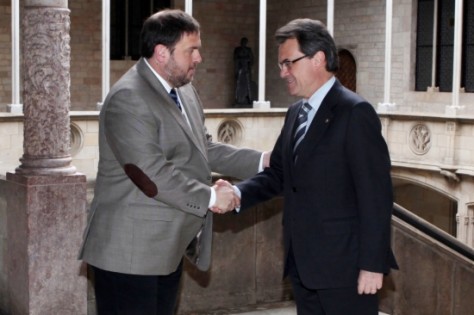
The governability accord between CiU and ERC has become a reality. Artur Mas (CiU) and Oriol Junqueras (ERC) have come to terms in a meeting at the Palace of the Generalitat. Artur Mas' investiture, for which Oriol Junqueras has once again pledged support, will take place Thursday and Friday, as was confirmed by the President of the Parliament, Núria De Gispert. The accord says that there will be a solemn declaration in the first session of the legislature with respect to the commitment to the right of self-determination; and it includes the commitment of CiU and ERC to hold a referendum on independence in 2014, with the possibility of postponing it if both parties agree.

On the referendum, Junqueras said that the accord guarantees the "necessary clauses for putting the future of Catalonia in the hands of its citizens". The commitment is to hold the referendum in 2014. But if CiU and ERC so agreed, it could be postponed.

Here is the document that lays out CiU and ERC's commitment to holding a referendum in 2014.

"There are still a few minor details that will surely be resolved on Wednesday morning," added Junqueras, who said he was very satisfied, since the accord also contained "changes in economic and social policy". And he added that a sample of this will to implement change is the announcement that the government-elect intends to apply a tax on bank deposits, just as the Republicans had requested.

Junqueras tweeted the news: "The challenges ahead are enormous. Today a new era begins: to get through the crisis and to hold a referendum on independence."

—Oriol Junqueras (@junqueras) 18 December 2012

Just before leaving the Palace, the ERC President shook hands with Francesc Homs, the government spokesperson-elect. Junqueras also confirmed that the investiture would take place at the end of this week.

Assessing the situation

CiU and ERC agree to work on consolidating a wide social majority that allows them to ensure the success of the referendum. That comes after it becomes clear that an important part of Catalanism—according to the agreement—had fully committed itself to transforming the state so that Catalonia could fit in better, but it has seen, and the "repeated negative replies" from Spain confirm, that this is a dead end.

It's for that reason that it is necessary to hold a referendum so that the people can freely and democratically decide their own future, and now we have "an opportunity that only presents itself once in many lifetimes". CiU and ERC note that various opportunities have come together: "the opportunity to construct a new country; the opportunity of the Catalan People to be the protagonist of its own story; the opportunity to put politics in the center of public debate; the opportunity to create a better society based on social justice and equality; the opportunity to reaffirm our commitment with democracy, with peace, and with Europe."

"Catalonia must have tools of state," continues the agreement, so that Catalonia can "develop its own nation building project to the widest degree". Both parties underscore that Catalonia could live much better off than currently if it had full access to the resources generated by its citizens and businesses and if it had the power to make decisions over what belongs to it and affects it.

Tuesday, December 11, 2012

European Parliament approves European-wide unitary patent; Spain opts out for linguistic reasons (!)

Originally published on Ciu.cat

Tremosa decries Spain's self-exclusion from the agreement and points out that 30% of the State's patents come from Catalonia

40 years after initiating negotiations, 25 Member states of the European Union have achieved the goal of coming to an agreement on creating a unitary European patent that would allow companies and individuals to patent a product in all (or almost all) of the countries in the EU in a uniform fashion. The European Parliament ratified the agreement by a wide margin, with a vote of 484 in favor to 164 against.

In addition to a huge reduction in the necessary bureaucracy, whoever wants to patent a product throughout the EU will see the costs notably reduced. The unitary European patent will reduce the cost by 80%. During the initial transition stage, the cost will fall to 2,380 euros. Once it's finalized, the cost of patenting a product throughout the EU will only be 680 euros.

This unitary European patent, therefore, is a huge step forward in the construction of the common market and will have important benefits for small and medium sized companies, universities, research centers, and citizen inventors.

Spain, however, has decided to exclude itself from the unitary European patent. according to State policy, followed both by Zapatero's PSOE party as well as Rajoy's PP, Spain has decided to stay out of the European unitary patent.

The reason is that Spanish is not considered an official working language, as are German, French, and English, as is normal in community institutions. Nevertheless, this fact would have no effect on citizens of the Spanish state since they would be allowed to present their patent applications written in Spanish. In addition, once these were recognized, they would be automatically translated to all of the EU languages.

Therefore, the Spanish state has refused to sign the agreement because of a linguistic formality, harming thousands of companies and entrepreneurs who base their potential growth on an increase of exports to the EU with value added products. And what is worse, in the vote today in the European Parliament, a large number of Spanish members from the PP and PSOE presented an amendment asking the European Parliament to refuse the creation of the European unitary patent and therefore kill it. They lost that vote 156 in favor to 511 against.

It's important to remember that 30% of the patents awarded in the Spanish State belong to Catalonia and therefore, Spain's self-exclusion greatly harms the interests of Catalan entrepreneurs.


There are also five videos of very short parliamentary speeches between Ramon Tremosa (Catalan MEP), Antonio Lopez-Istúriz White of the PP, and Antonio Masip Hidalgo of the Spain's Socialist Party. (The first two are in English, the remaining ones are in Spanish.)

1. http://www.youtube.com/watch?v=wgLPNh2NZME&feature=youtu.be

2. http://www.youtube.com/watch?v=QFEw-JVqYc0&feature=youtu.be

3. http://www.youtube.com/watch?v=DLnxrpgcFAs&feature=youtu.be

4. http://www.youtube.com/watch?v=SogbHimLTgw&feature=youtu.be

5. http://www.youtube.com/watch?v=KD2DIo28EsY&feature=youtu.be


Also see: European Patent Office welcomes historic agreement on unitary patent

For more information, please contact: Aleix Sarri i Camargo/ Assistant to Ramon Tremosa, +32 489053314 /[email protected]

Thursday, December 6, 2012

Catalan vote from abroad would have altered make up of Parliament

Originally published in Vilaweb, 6 December 2012

Difficulties in voting drastically lowered turnout - Under normal conditions, the results would have been different, in favor of CiU and ERC

The election returns from Catalans who reside outside of Catalonia would have changed the make up of the Parliament, with more seats in favor of sovereigntist parties, but the obstacles to voting resulted in a drastically lowered turnout, as a report written by the International Federation of Catalan Organizations explains.

According to this document, only 9,538 valid votes were counted. That figure, including the null votes, represents a turnout of 6.74% of the total of 156,976 Catalans who are registered to vote abroad. The turnout was higher than that of recent elections in the Basque Country and in Galicia, revealing the high interest that this election had engendered. It is a very low turnout, however, with respect to previous Catalan elections. For example, in 2008, there was 20% turnout.

The Federation believes that the new regulation has made it very difficult to vote from abroad and points out that there are entire communities, like that of most of the Catalans in the United States, who received no documentation regarding the elections and who were unable to vote.

This fact becomes even more relevant when the returns are analyzed. Both CiU and ERC have stronger results among foreign-residing voters—4 points more for CiU and 2 points more for ERC. In contrast, PSC, PP, and Ciutadans all had lower percentages. A high turnout, therefore, would have altered the distribution of seats in the parliament. According to the Federation's calculations, CiU would have won 4 more seats, at the expense of Ciutadans and PSC.

Wednesday, November 28, 2012

President Mas and Opposition Leader Junqueras began to explore agreement on legislature

By Josep Casulleras Nualart. Originally published in Vilaweb on November 28, 2012

Oriol Junqueras, the president of ERC announces that ERC will not form part of the government, but instead has offered support on the investiture, budget, foreign affairs, and referendum on independence


The negotiation between CiU and ERC in order to get to an agreement that ensures the governability of the country as well as the celebration of an independence referendum during the next legislative session has begun. Today Artur Mas and Oriol Junqueras had lunch together at the Palau (Catalan government building) and in a cordial setting, they exchanged impressions: Mas wants the Republicans to form part of the government, and the president of the Republican Left has announced that they will not do so, but that they are committed to guaranteeing the government's stability in four key areas: the investiture of the president, the budget, foreign affairs, and the independence referendum.

The Republicans don't want to form part of the government but they have committed themselves to guaranteeing its stability from the outside. Junqueras says that he is convinced that he has correctly interpreted the will expressed at the polls, according to statements he made today to Catalunya Ràdio. In exchange, ERC wants assurances that the independence referendum will continue forward and that the budget cuts be softened.

The Republicans are aware of the fact that even if they don't form part of the government, if they want to offer stability to CiU's government, they will have to accept that some additional budget cuts will have to be made. Yesterday, government spokesperson Francesc Homs warned that similar budget cuts will be necessary in 2013 as there were in 2011 and 2012. But ERC aims to soften the austerity plan, and to implement changes in fiscal policy with measures like the reversal of the 1 euro per prescription drug plan, or the reinstatement of the inheritance tax on the highest brackets.

Today, then, Mas and Junqueras inaugurated the negotiations, and put their cards on the table. And according to sources close to the conversation, they are preparing to delve deeper into the negotiations, with the participation of a team of economists who will be studying budget-related matters as well as a team of judicial experts who will analyze the steps necessary so that the people of Catalonia can be consulted on independence.


ERC (Esquerra Republicana de Catalunya, Republican Left, and often referred to as the Republicans, but in the sense of Republic, not GOP) is the traditional centre-left independentist party in Catalonia. They won 21 seats (up from 10) in the Catalan Parliament on November 25th, and were the second most voted party. Their leader is Oriol Junqueras.

CiU (Convergència i Unió, Convergence and Union) is a centre-right coalition of CDC (social democrats) and UDC (Christian democrats), who won 50 seats in the Catalan Parliament, (down from 62) and thus are the most voted party. Their leader is Artur Mas, who will be the President of the new parliament.

Monday, November 26, 2012

Who won in Catalonia?

I drove down to New York yesterday to watch the Catalan election returns with more than 100 Catalan expats in the Socarrat paella bar. The croquetas were delicious, if a bit expensive.

The first reactions were incredulity, combined with sadness. As the night wore on, the results improved, and so did the mood. But it certainly wasn't the jubilant party that some (yes me!) had hoped for.

So what happened? And perhaps first, what were they voting for? The Catalan President Artur Mas had called early elections after three important events: the massively attended march for Catalan Independence on September 11th, the definitive "no" received from Spanish President Rajoy shortly thereafter to an improved financial deal for Catalonia, and the lingering effects of the "whittling away" of Catalonia's 2nd Statute of Autonomy, at the hands of the rightist, unionist PP, despite it having duly passed by referendum, in the Catalan Parliament, and even in the Spanish Parliament.

Mas didn't have to call elections. But, and this is very important, he knew that the international community (or Spain) would never accept a push for independence from a party that had run on a platform that didn't include independence. The fact that Mas called early elections, despite the risk, shows that he was putting the legitimacy of independence ahead of his party's security. This should not be overlooked. And although I was frustrated by Mas’ vocabulary—he steadfastly refused to use the word independence—I was impressed with the democracy reflected in his speeches, and for the clear awareness that there is no future for Catalonia within Spain, that Catalonia must have its own state.

But CiU is a complicated coalition. They have been the majority force in Catalonia almost since the transition to democracy, and many saw their recent conversion as politically motivated. They said derisively that Mas was following the people, riding the wave, which frankly, I'm not so sure is such a bad thing. However, the disastrous decision to show the president in a Moses-like pose on the campaign posters played right into the hands of those who claimed the new-found independentism was just a front to solidfy Mas' personal power.

At the same time, CiU's coalition refused to jettison the extremely divisive Josep Antoni Duran i Lleida, who constantly and pointedly reminded anxious voters that he believed Catalonia didn't make sense without Spain, or Spain without Catalonia and that CiU's platform did not include the word "independence". Duran completely torpedoed Mas' credibility and should be held accountable for much of CiU's failure to convince voters of their desire for “their own state” or however they wanted to word it.

CiU paid dearly for these mistakes. From 62 seats, they fell to 50. (No poll had predicted such results, hence the incredulity. They need Nate Silver badly.) But 50 seats is still 2.5 times as many as the 2nd power, and more than all the unionist parties combined. All is not lost.

Let's talk about that second power: ERC, the “Republican Left”. Republican in the sense of a Catalan Republic, not Mitt Romney! This is the traditional independentist party, the same party that declared the Catalan Republic in 1931, and whose democratically elected president was handed over by Franco to the Nazis, who promptly executed him.

But it is also the ERC who lost huge amounts of credibility and political capital during the seven years that they put independence aside in an effort to advance a more leftist social program together with the Socialists and Greens. This so called "tripartit" or "threeparty" put Socialists in the Presidency of the Catalan Government (Generalitat) for the first time since the transition, and ERC bet on gaining prestige and experience in office, rather than furthering independence.

Unfortunately for them, the Catalan Socialists were wed (or chained, depending on how you look at it) to the very centralist Spanish Socialists, and the Greens have always been more interested in social policy than independence, stubbornly refusing to see how the latter determines the former. The terrible ruling of Spain's Constitutional Court, in which the new Catalan Statute of Autonomy was further destroyed, was evidence that ERC's bet had failed miserably, evidenced by their electoral results in 2006 and 2010.

So CiU returned to power in 2010 on a platform of fiscal discipline at home and fiscal pact with Madrid. They found the coffers empty and no one willing to take the blame, certainly not the Catalan Left coalition of Socialists, Greens and ERC. And then, thanks to pressure from the banking crisis and Brussels, the Spanish President began to turn the screws, refusing to deliver billions of dollars in funds already budgeted to Catalonia. CiU, whose economic policies are much closer to the Spanish President's PP party than to that of the Catalan left, may have been surprised to find that the PP had left them high and dry. CiU for many years has secured crumbs from the Spanish table thanks to its alliances with the PP. Now that the table was more bare, the PP turned its back on CiU, preferring to spend its decreasing funds elsewhere, for example in Andalusia and Galicia.

So CiU bet on the “fiscal pact”: a demand that Spain fix the desperately unfair system of taxation in which Catalonia transfers almost 9% of its GDP to fund toll-free rolls, high speed trains, and brand new hospitals and schools in Spain, while going without at home. (That 9%, or some 20 billion US dollars, are above and beyond what Catalans pay in taxes and get back in services and infrastructure.) At the same time, CiU pledged to clean up the fiscal situation, by implementing the budget cuts demanded by the central government. An almost impossible combination, which was not helped by the fact that any concessions that Spain's PP had extracted from Brussels were not shared with Catalonia, adding to CiU's frustration with its former partner.

The Greens and Socialists pounced, blaming CiU for unraveling the social safety net. I was particularly perplexed when at the end of 2011, and Spain had reneged on delivering already-budgeted funds to Catalonia, thus forcing CiU to delay payments and make further cuts, that the left's criticism was not to Spain but to CiU. In my opinion, they took political potshots instead of responsibility.

After the massive September 11th march, and Rajoy's definitive "no" to the fiscal pact, Mas chose sovereignty. He didn't have to, and I think deserves some credit for doing so. And Esquerra (ERC), to their credit, has been fair. While they have demanded improved social policy and more prioritized budget cuts, they have not attacked Mas personally. And they were rewarded in the polls, rising to 21 seats, and the second force in the Parliament. Much of their rise is thanks to Oriol Junqueras, their new leader, who is intelligent, focused, and willing to negotiate.

The rest of the results were for me, less hopeful, or more ambiguous. I expected the Catalan Socialists, who campaigned on the impossible platform of “federalism”—rejected even by their own Spanish Socialist partners, to fall farther than the 8 seats they lost (to 20). The Catalan wing of the People's Party, the same rightist party in power in Madrid gained one seat, and Ciutadans, a pro-unionist party gained six, thanks to its vicious fear campaign: they scurrilously claimed that an independent Catalonia would require people to Catalanize their names, that university degrees would no longer be recognized, and probably most damaging: that Catalonia would be "expelled" from Europe, as if that were even possible.

The Catalan Greens gained three, capitalizing on people's continued mistrust of CiU on independence, and especially over anger over budget cuts. And they blamed CiU for the police violence that occurred during the general strike on November 14, right in the middle of the electoral period. It frustrates me that they took no responsibility for their own role in financial woes, and that their attacks on Mas have been so personal and so virulent. The leader of the Greens, Joan Herrera, feels more opportunist to me than any other party leader.

And finally, a new party has emerged, and another has disappeared. The CUP, which is a grassroots, leftist and pro-independence movement (not party) won 3 seats, while Solidaritat, a purely pro-independence party, lost their three. I don't know the first group well enough to talk about them. I will miss Solidarity's focus and dedication, if not their sharp tongues.

In the end, I think that instead of focusing on CiU's decline, we should recognize independence's rise. In the previous parliament, there were 14 MP's who were on the record in favor of independence. In the new Parliament, there are 74, not counting an additional 20 or so MPs from the Greens and Socialists who are at least in favor of the right to self-determination. President Mas has said he will forge ahead with the referendum for Catalan independence, and Oriol Junqueras, has repeatedly said he would support Mas in such an endeavor. Junqueras' role will be crucial and complicated, as ERC and CiU are now wholly dependent on each other, for both independence and sound fiscal policy. The intelligence and attitude of both leaders gives me hope they will find a way on both issues.